![[Translate to English:]](/storages/sfs-sowi/r/Bilderpool/Header/header_collage_sfs_eving_sozialforschungsstelle_dortmund.jpg "[Translate to English:]")
2026
Science, Innovation and Society: sfs at the EU-SPRI Forum 2026

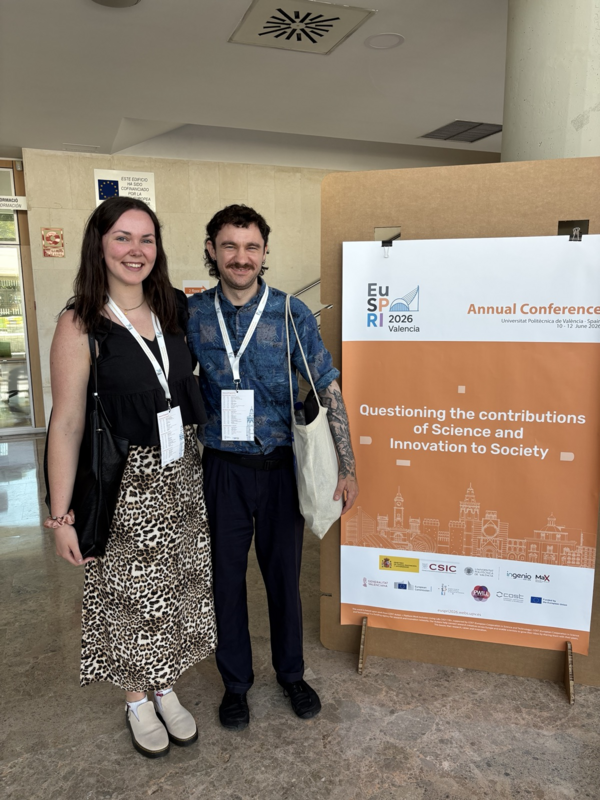
Under the theme ‘Questioning the contributions of Science and Innovation to Society’, this year’s Eu-SPRI Forum conference in Valencia took a critical look at the contribution of science and innovation to society in its panel discussions and keynote speeches. It was repeatedly emphasised that the scientific examination of innovation and innovation policy must keep its focus on its relevance to current societal developments and continuously engage in critical reflection in this regard. Keynote speaker Andy Stirling, for example, highlighted how narrowly focused innovation policies could be broadened, complemented by democratic processes and better accommodate the plurality of innovation.
A similar tone was frequently struck in the conference’s streams and sessions, and the diversity of innovation and the importance of practice-relevant innovation research were highlighted by a wide range of contributions. Social innovation was a recurring theme in many presentations, and not only in streams and sessions where the topic was the main focus. Rather, it became apparent that social innovation is a cross-cutting theme that runs through many papers with a wide variety of focal points.
Researchers from the Faculty of Social Sciences at TU Dortmund University (Social Research Center and the Heisenberg Professur ‚Sociology of Work and Organisation‘) organised the streams ‘Social innovation in turbulent times’, ‘Responsible research and innovation in health: emerging challenges for governance and practice’ and ‘Dialogues on the directionality of innovation: alternative innovation paradigms from the Global South’. This way, they devoted considerable attention to perspectives on social innovation and other, alternative approaches to innovation, which met with great interest from conference participants. In addition, there were contributions from SFS researchers in various sessions.
In the stream ‘Social Innovation in turbulent times’, organised by Karina Maldonado-Mariscal, Jürgen Howaldt, Rick Hölsgens, Bonno Pel, Elisabeth Unterfrauner, Doris Schartinger, Matthias Weber, Marthe Zirngiebl, Katrin Ostertag und Jakob Edler, two sessions were held. The first session addressed theoretical questions, measurements and processes, as well as a survey on social innovation. The second session focused more strongly on governance and power. Karina Maldonado-Mariscal presented joint research on ‘Trajectories of Exnovation’.
The stream ‘Dialogues on the directionality of innovation: alternative innovation paradigms from the Global South’, organised by Álvaro Fernández-Baldor, Karina Maldonado-Mariscal, Tiago Brandão and Carolina Bagattolli, featured an international discussion. There were three sessions in this stream. The various approaches to innovation from different regions attracted particular interest: Buen Vivir in Guatemala; Buen Vivir and social technology in southern Mexico; traditional sailing in Colombia; perspectives on power and institutionalisation from Canada; farmers in Ecuador; exclusive innovation policy; maker spaces in an African context; and the dynamics of transition in cycling-friendly cities in Brazil.
In the stream ‚Responsible research and innovation in health: emerging challenges for governance and practice‘, organised by Julius Wiegand and Katharina Hast (Faculty of Social Sciences, Sociology of Work and Organisation) along with other Spanish colleagues, a total of four sessions were held. The first two sessions focused on AI-supported innovation ecosystems, pharmaceutical and biotech dynamics, and regulatory pathways for orphan drugs. The third session focused on public participation, disease burdens and climate risks, whilst the fourth session centred on responsibility, values and public deliberation in controversial health research contexts. Drawing on these diverse case studies, the overarching conference theme relating to innovation and health was the subject of lively debate.
In their presentation ‚Operationalising science-policy co-creation in EU Missions: Reflections from the Social Innovation Mission Facility‘, Marthe Zirngiebl and Jürgen Howaldt presented the initial findings of a review from the EU project Social Innovation Mission Facility, highlighting the role of social innovations in EU missions. The special session ‚Missing in Action – Social Innovation for the next generation of goal-oriented R&I policy in Europe: From Policy Rhetoric to Practice‘ organised by project coordinator Wolfgang Haider (Centre for Social Innovation) together with Jürgen Howaldt addressed the question of how social innovations can be given sufficient consideration in the establishment of mission-oriented innovation policy across all stages, from programming through governance to implementation.
In the presentation ‘Integrated digital, technological and social innovations: Case study of a company on its way to energy self-sufficiency’, Lana Fassbender highlighted a company that has successfully embarked on the path towards energy self-sufficiency within just a few years. The discussion centred on the impact of the interplay between technical, social and digital innovations on this transformation, and the role that small and medium-sized enterprises play in achieving climate neutrality in cities.
The presentation ‘Impact of research and innovation policies on the diffusion and establishment of social innovation offerings at German higher education institutions’ focused on the conditions necessary for the long-term establishment of activities relating to social innovation in research, teaching and knowledge transfer at German universities. A key focus of the presentation in the session ‘Private and public research organisations in transforming innovation systems: rethinking governance, capabilities and shared value creation for systemic change’ was the importance of funding programmes as an innovation policy incentive for universities. The paper presented by Daniel Krüger, in collaboration with Katrin Bauer, Christoph Kaletka, Ralf Kopp Marthe Zirngiebl, Alexander Dederichs und Carlotta Buchholz, thus tied in with the discussions surrounding the issue of universities assuming social responsibility and the corresponding reorientation of these institutions, and was the subject of lively debate with regard to its internationally relevant implications.