SIGU platform Zukunftsfabrik: Fostering the Social Innovation Ecosystem
- News
- Projekte
- SIGU

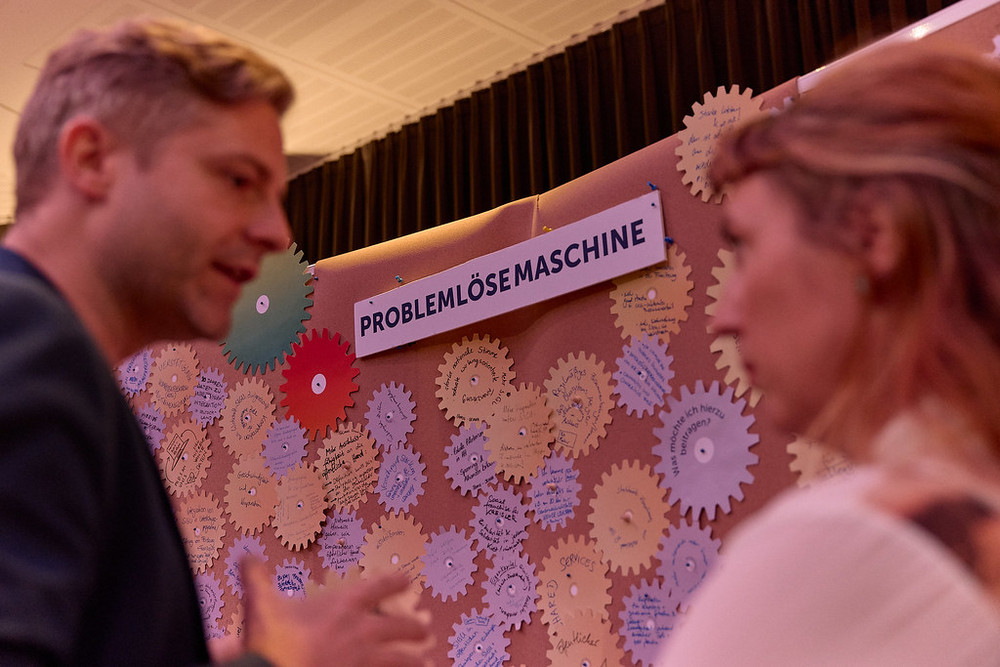
On October 14, 2025, the SIGU platform invited stakeholders from academia, practice, administration, and civil society to the Zukunftsfabrik —a central workshop and networking day designed to identify ways to further develop the ecosystem of social innovation in Germany. Under the motto "Strengthening partnerships. Shaping ecosystems. Unleashing impact," the event provided a space for exchange, joint reflection, and the development of new options for action to promote social innovation.
The Social Research Center (sfs) at TU Dortmund University, as the scientific partner in the SIGU platform project, was also actively represented on this day. Prof. Dr. Jürgen Howaldt, Dr. Katrin Bauer, Daniel Krüger and Marthe Zirngiebl, contributed their scientific expertise to the discussions and workshops and helped shape key program items.
In his keynote speech “Unleashing the potential of social innovation – expanding alliances and ecosystems,” Prof. Dr. Jürgen Howaldt emphasized the importance of strong networks and cooperation for the success of social innovation. In order to develop their impact, he stated, a well-connected support ecosystem is needed that brings together science, practice, administration and civil society. The Director of the sfs made this connection clear with several international examples and at the same time built a bridge to Germany, to the developments of recent years and to the current situation, in which it is now important to look ahead.His keynote speech kicked off the in-depth workshops at the Zukunftsfabrik.
One focus of the Zukunftsfabrik was on the question of how research, teaching, and transfer (aka third mission) can be integrated with the practice of social innovation. In the workshop “SIGUs and Science – the Contribution of Research, Teaching, and Transfer,” participants discussed with the workshop heads Dr. Katrin Bauer and Daniel Krüger (sfs) as well as the impulse speakersSarah Baumann and Michael Kriegel (both TH Rosenheim) how universities can contribute to the sustainable development of the SIGU ecosystem. Practical examples showed how social innovations are integrated into research and teaching and what structural conditions are needed to anchor cooperation, knowledge exchange, and co-creation more firmly. It became clear that social innovations and social entrepreneurs benefit particularly when universities act as active partners and systematically promote exchange with society.
In addition to the link between science and practice, the focus was on other future topics: How can digital tools and platforms support the work of SIGUs? Which funding strategies are suitable for securing sustainable structures? Which governance models does a growing ecosystem of social innovations need? Strategies and solutions were developed in several workshops – ranging from the digital organization of support structures and new financing models to the design of shared learning and communication spaces. The results are now being incorporated into the SIGU platform's ongoing work and will help shape the future direction of the network.
The sfs's participation in the Zukunftsfabrik underscores its role as a catalyst and interface between science and social practice. For many years, the team has been researching social innovation processes, their conditions for success, and their effects—and contributing this knowledge to national and international projects. Through the exchange at the Zukunftsfabrik, the experiences of the sfs representatives flowed directly into the dialogue with practitioners, funding institutions, and political decision-makers. At the same time, the format provided valuable inspiration for the further development of the sfs's own agenda.
With the Zukunftsfabrik, the SIGU platform has provided important impetus for the strategic development of the social innovation ecosystem. The sfs will continue to actively support this process, as a scientific partner in the project, and thus both scientifically and by helping to shape future events and research initiatives. The results of the Zukunftsfabrik show that sustainable structures for social innovation can only be created through the interaction of science, civil society, practice, and politics—a cause that the sfs will continue to help shape in the future. This was also stated by Dr. Katrin Bauer on behalf of the project manager PD Dr. Christoph Kaletka and the SIGU team at sfs in the concluding short retrospective at the Zukunftsfabrik, in which the three project partners Social Impact gGmbH, SEND e.V. and TU Dortmund University gave a summary.
If you would like to read more about the current situation of social innovation in the EU, the article Europe's Social Innovation Revolution: From Crisis Response To Systemic Transformation by Jürgen Howaldt and Sofia Lai Amândio (University Institute of Lisbon) offers an interesting insight.